High Bandwidth CoaXPress 2.0 BNC Cable: New Standard for Machine Visi...
The relentless push for higher resolution, faster frame rates, and more complex 3D or multi-spectral imaging in machine vision is pushing traditional interfaces like USB3 Vision and GigE Vision to their limits. In this environment, the CoaXPress 2.0 cable with BNC or Micro-BNC (HD-BNC) connectorshas emerged as a critical enabler, establishing itself as the new standard for high-performance industrial imaging systems .
This article provides a comprehensive guide to understanding CoaXPress 2.0 cables, from their technical specifications and key benefits to practical selection and usage advice for engineers and system integrators.
🚀 What is CoaXPress 2.0 and Why It Matters
CoaXPress (CXP) is a high-speed digital interface standard specifically designed for machine vision, medical imaging, and other demanding applications requiring the transfer of large image data volumes with low latency. It uses standard 75 Ω coaxial cables and supports data, control, triggering, and power over a single cable .
The CoaXPress 2.0 standard, finalized around 2017–2018 and updated to 2.1 in 2021, is a significant evolution from version 1.1/1.1.1. Its key advancements include :
Higher Data Rates: Introduction of CXP-10 (10 Gbps)and CXP-12 (12.5 Gbps)per lane, doubling the maximum per-lane speed.
New Connector: Standardization of the compact and robust Micro-BNC / HD-BNCconnector for CXP-10/12.
Enhanced Features: Doubled uplink speed for triggering/control, support for GenICam and GenDC, and the optional CoaXPress-over-Fiber extension .
For machine vision, this translates to a powerful combination: multi-gigabit bandwidth, cable lengths of tens of meters, low latency, and the ability to power the camera via PoCXP (Power over CoaXPress). This makes CoaXPress 2.0 the interface of choice for applications that were previously limited by Camera Link or early USB/GigE standards .
🔌 CoaXPress 2.0 Cable Specifications
A CoaXPress 2.0 cable is more than just a wire; it’s a precision transmission line engineered for 12.5 Gbps signals. Here are its critical specifications.
Connector Types
BNC: The classic 75 Ω connector, still used in many CoaXPress 1.x systems and some 2.0 setups for legacy or cost-sensitive applications.
DIN 1.0/2.3: A smaller, high-density connector used in some CXP-6 (6.25 Gbps) systems.
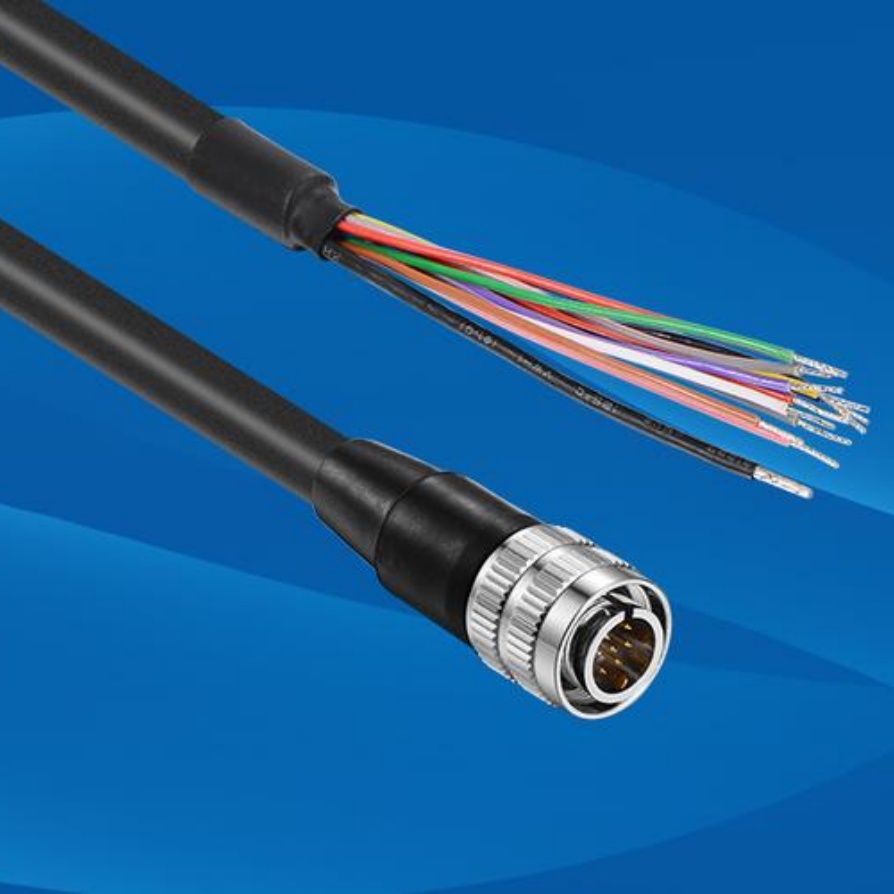
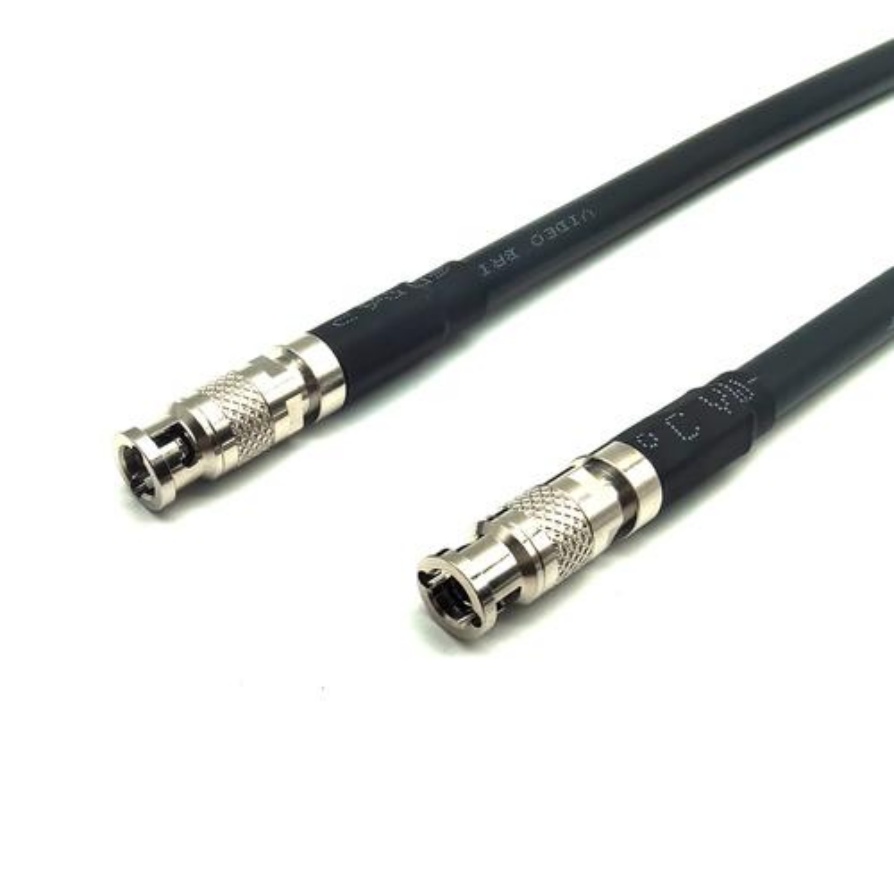
Micro-BNC / HD-BNC: The recommended standard connector for CoaXPress 2.0 (CXP-10/12). It combines the secure locking of BNC with a much smaller footprint, ideal for multi-camera and space-constrained designs .
Bandwidth and Data Rates
CXP-1 to CXP-6: 1.25 Gbps to 6.25 Gbps per lane.
CXP-10: 10 Gbps per lane.
CXP-12: 12.5 Gbps per lane– the primary choice for new high-bandwidth designs .
Multiple lanes can be aggregated for even higher total bandwidth:
4x CXP-12: 50 Gbps total.
8x CXP-12: 100 Gbps total .
Cable Length vs. Speed
The maximum reliable cable length depends heavily on the data rate and cable quality. CoaXPress 2.0 (CXP-10/12) is specified for high speeds over tens of meters, not hundreds.
Data Rate
Typical Max Cable Length (High-Quality Cable)
12.5 Gbps (CXP-12)
20–30 meters
10 Gbps (CXP-10)
30–40 meters
6.25 Gbps (CXP-6)
40–100+ meters
3.125 Gbps (CXP-3)
100+ meters
Key Takeaway: For a new 25–65 MP, high-frame-rate system, you should plan for CXP-12 over Micro-BNCwith a cable length of 15–30 metersas a practical design target .
Power over CoaXPress (PoCXP)
CoaXPress cables can deliver power to the camera, simplifying cabling:
CXP 1.1: Up to 13 W per cable at 24 VDC.
CXP 2.0: Supports 13 Wor an enhanced 37 Wmode for more power-hungry cameras .
Important: Many camera vendors require at least two active CXP data lanes to be connected to enable PoCXP. Always consult the camera manual .
Signal Integrity Parameters
For reliable 12.5 Gbps operation, the cable must meet stringent electrical specs :
Characteristic Impedance: 75 Ω ± 4 Ω.
Return Loss: Better than –15 dB at the operating frequency.
Attenuation: Less than –17.9 dB at the operating frequency (e.g., ~6.25 GHz for CXP-12).
Frequency Range: Typically specified up to 1–6.25 GHz for CXP-12 .
Using certified CoaXPress 2.0 cables from reputable manufacturers is the best way to ensure these parameters are met .
💡 Benefits of High Bandwidth CoaXPress 2.0 BNC Cables
Unmatched Bandwidth for High-Resolution Imaging A 4-lane CXP-12 cable provides 50 Gbpsof image data bandwidth. This is sufficient for a 25 MP camera at 150 fpsor even 65 MP at 60+ fps, which would overwhelm most GigE or USB3 Vision links .
Long-Distance Transmission Reliable operation over 20–30 meterson a single cable is a major advantage over the typical 5–10 meter limit of USB3/GigE, crucial for large-scale inspection systems .
Simplified System Wiring A single CoaXPress cable can handle data, control, triggering, and power (PoCXP). This reduces cable clutter, connector count, and potential points of failure, which is especially beneficial for multi-camera rigs .
Low Latency and High Synchronization The protocol is designed for minimal, deterministic latency, which is critical for high-speed applications like 3D AOI/SPI and motion analysis. Features like the high-speed uplink (up to 41.6 Mbps) and event packets ensure precise, low-jitter triggering across multiple cameras .
Proven Reliability CoaXPress has a decade-long track record in demanding industrial and medical applications. The standard’s use of shielded coaxial cable provides excellent immunity to EMI/RFI, a common challenge on factory floors .
🎯 Key Applications
High-bandwidth CoaXPress 2.0 cables are the backbone of many advanced vision systems :
Electronics Inspection: 2D/3D AOI and SPI for PCBs, displays, and semiconductors, where high resolution and speed are paramount.
Flat Panel & Solar: Inspection of large-area panels and solar cells, requiring long cables to cover the full surface.
Logistics & Traffic: High-resolution, high-frame-rate systems for tolling, traffic monitoring, and sports analysis.
Medical & Life Sciences: Microscopy, ophthalmology, and surgical imaging, where image quality and low latency are non-negotiable.
Robotics & Industrial Automation: Robot-mounted vision systems that require cables with high flex life to withstand constant motion .
🛠️ How to Choose the Right CoaXPress 2.0 Cable
Follow these steps to select the optimal cable for your system:
Match the Data Rate: For new designs, choose CXP-12to maximize sensor performance. Only opt for CXP-6 or lower if you have legacy hardware or extreme distance requirements .
Select the Right Connector: Micro-BNC (HD-BNC)is the standard for new CXP-12 systems. Use BNC for legacy 1.x systems or cost-sensitive setups. DIN 1.0/2.3 is for specific CXP-6 gear .
Determine the Cable Length: For CXP-12, design for 15–25 metersas a safe target. For CXP-6, you can consider 30–40 meters. For longer distances, explore fiber extenders or repeaters .
Verify PoCXP Requirements: Check your camera’s power needs. If it requires more than 13 W, ensure you select a CXP 2.0 cable rated for 37 Wand follow the manufacturer’s guidelines for the number of active lanes .
Prioritize Flexibility and Durability: For robotic or moving-cable applications, look for cables specifically rated for high flex cycles (e.g., >1 million). For static or limited-motion setups, standard construction is sufficient .
Choose Certified Cables: Use cables that are explicitly certified for CoaXPress 2.0 and specify their maximum supported speed and power. This ensures signal integrity and compatibility .
🔧 Installation and Best Practices
Cable Management: Avoid tight bends (use a minimum bend radius of 10x the cable diameter) and prevent cables from being crushed or stretched. In cable chains, use high-flex rated cables and allow for smooth, gradual curves.
Connector Handling: Always fully insert and lock the connectors. Avoid rotating the connector body while mated to prevent damaging the contacts. Use torque-limited tools if specified.
Strain Relief: Use clamps or brackets to support the weight of the cable and connector, preventing stress on the solder joints.
Environmental Protection: For harsh environments, choose cables with appropriate IP-rated jackets (e.g., IP65/IP67) and shielding.
Testing and Validation: After installation, perform a test run to check for image artifacts. Many CoaXPress devices have built-in link quality diagnostics to help identify marginal cables .
🔄 CoaXPress 2.0 vs. Other Interfaces
Feature
CoaXPress 2.0
GigE Vision
USB3 Vision
Max Bandwidth (per link)
12.5 Gbps
1–10 Gbps
5–20 Gbps
Typical Cable Length
20–30 m
100 m
3–5 m
Power over Cable
Yes (PoCXP)
Yes (PoE)
Limited
Latency
Very Low
Higher
Low
System Cost
Higher (frame grabber)
Lower
Lowest
Best For
High-end, long-reach, multi-camera
Large-area, distributed systems
Simple, single-camera setups
🌏 The Rise of Domestic CoaXPress Components
The CoaXPress ecosystem is no longer confined to a few global players. Domestic manufacturers, particularly in China, are now producing high-quality Micro-BNC and BNC connectors that meet the stringent requirements for 12.5 Gbps transmission. These components offer cost savings of 30–40%, shorter lead times, and customization options, making high-performance CoaXPress 2.0 systems more accessible .
🏁 Conclusion
The High Bandwidth CoaXPress 2.0 BNC/Micro-BNC cableis more than just a connector; it is the essential physical layer that unlocks the full potential of modern high-resolution, high-speed machine vision systems. By understanding its specifications, benefits, and application requirements, you can design robust, future-proof vision systems that meet the most demanding industrial and scientific challenges.
Meta Description: Discover the Flexible & Bend-Resistant Vision Cable, engineered for precision imaging in demanding environments. Durable, reliable, and built to last. Perfect for industrial, medical, and robotic applications.
Int.
Meta Description: Discover premium Robotic Vision System Cables engineered for seamless data transmission, durability, and precision in industrial automation. Ensure flawless vision system performance.
Enhance Automation Precision with.
Subtitle: A High-Performance Signal Cable Designed for 3D Scanners, Ensuring Lossless Data and Minimal Latency
Product OverviewThe 3D Scanner Vision Signal Cable is a premium signal transmission cable engineered for both industrial a.
Elevate your visual data transmission with the IP67 Waterproof Vision Connection Cable, engineered to deliver seamless performance in the harshest conditions. Designed for industrial, outdoor, and mission-critical applications, this rugg.
The Precision Imaging Dedicated Vision Cable is a cutting-edge connectivity solution designed to deliver crystal-clear image transmission in high-stakes environments. Optimized for industrial automation, medical imaging, machine vision, .
Shielded Twisted-Pair Vision Cable – Ultra-Clear Signal Transmission for Demanding Environments
Ensure flawless video and data transmission in high-interference environments with our Shielded Twisted-Pair (STP) Vision Cable. Engineere.
Product Overview: Machine Vision Cables
Machine vision cables are specialized components designed to ensure high-speed, stable data transmission and signal integrity in automated imaging systems. Key features include:
Technical S.
Enhance the reliability and performance of your automated systems with our Industrial-Grade Machine Vision Cable—engineered to deliver unparalleled signal integrity, durability, and speed for demanding industrial applications. Designed f.
High-speed factories demand flawless synchronization between machines and vision systems. Yet, challenges like electromagnetic interference (EMI), cable fatigue, and data bottlenecks often disrupt operations. The right machine vision cab.
Meta Description: Experience seamless 4K/8K video transmission with our High-Speed Anti-Interference Vision Cable. Engineered for crystal-clear visuals, robust durability, and interference-free performance. Perfect for gaming, profes.